
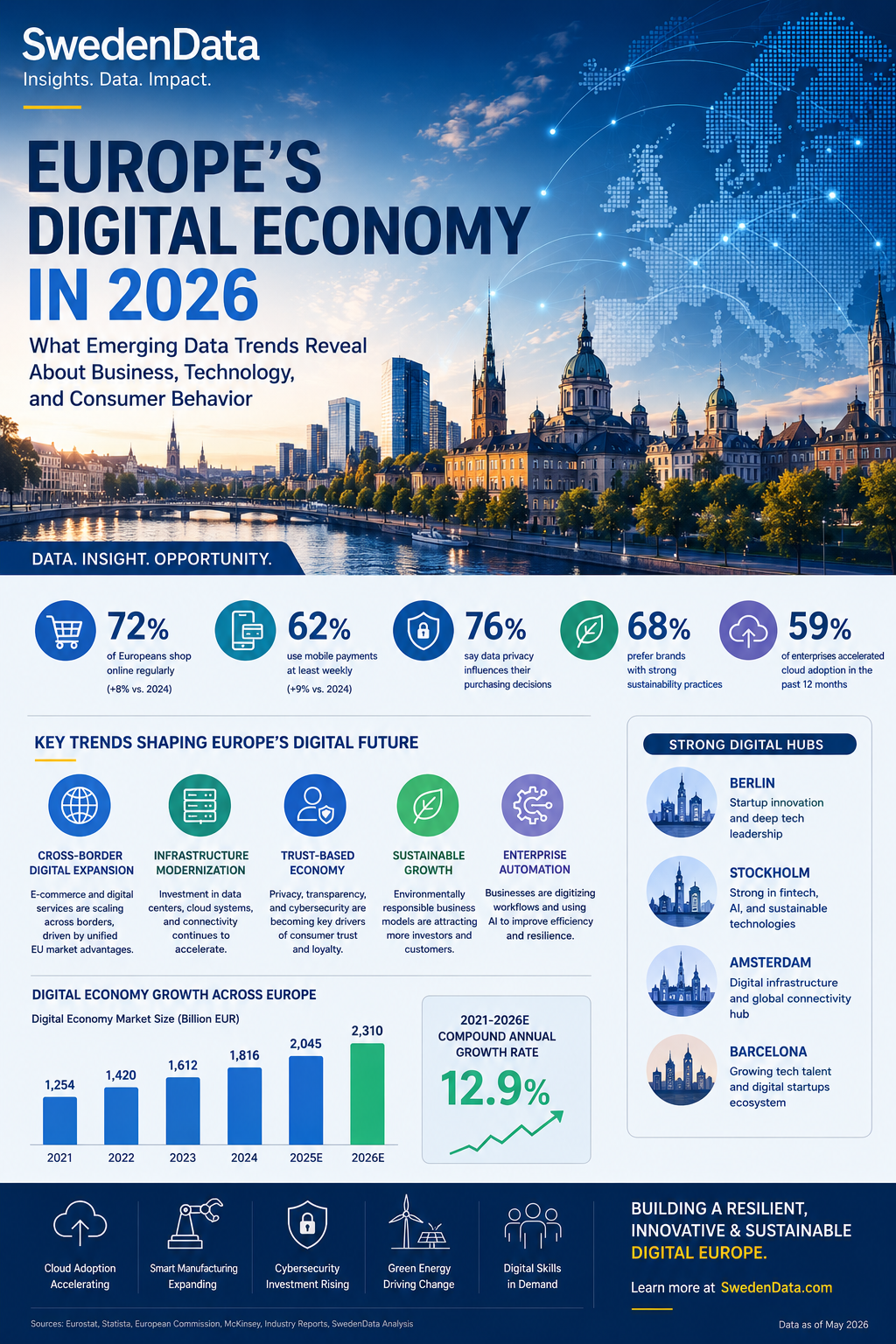
Europe’s Digital Economy in 2026: What Emerging Data Trends Reveal About Business, Technology, and Consumer Behavior
Europe’s digital economy is entering a new phase of transformation. While artificial intelligence continues to attract global attention, the broader story unfolding across the continent is far more complex — involving changes in consumer behavior, cross-border commerce, infrastructure investment, digital regulation, sustainability priorities, and enterprise modernization.
At SwedenData, we analyzed recent market indicators, industry reports, investment movements, and evolving digital consumption patterns across major European markets. The findings suggest that Europe is quietly building one of the world’s most resilient and diversified digital business ecosystems.
Consumer Behavior Is Becoming Increasingly Digital-First
One of the strongest shifts observed across Europe is the acceleration of digital-first consumer behavior.
Online purchasing habits, mobile payment adoption, subscription services, and digital platform engagement continue to expand across nearly every age group. While younger consumers remain highly active online, middle-aged and older demographics are also becoming increasingly comfortable with digital services.
Several key patterns stand out:
- Mobile commerce continues to grow steadily
- Consumers are spending more time within digital ecosystems
- Trust and data privacy increasingly influence purchasing decisions
- Subscription-based services are becoming mainstream
- Cross-border online shopping is rising across the EU market
This evolution is reshaping how brands approach customer acquisition, localization, and long-term retention strategies.
Europe’s Cross-Border E-Commerce Market Is Expanding
The European Union’s interconnected market structure continues to create significant opportunities for digital commerce.
Businesses are increasingly targeting multiple European markets simultaneously rather than focusing on a single country launch strategy. Improved logistics systems, digital payment integration, and multilingual marketing tools are helping companies scale more efficiently across borders.
Countries such as Germany, France, Spain, Italy, and Netherlands remain among the region’s most influential digital commerce markets.
At the same time, smaller markets in Northern and Eastern Europe are showing faster-than-expected digital growth rates, particularly in:
- Online retail
- Financial technology
- SaaS adoption
- Digital entertainment
- Remote work infrastructure
Data Privacy Is Becoming a Competitive Advantage
European consumers are paying closer attention to how companies collect, manage, and use data.
Privacy concerns are no longer limited to regulatory discussions — they are increasingly influencing brand reputation and customer trust.
Businesses that demonstrate:
- Transparent data policies
- Strong cybersecurity practices
- Responsible digital advertising
- Secure payment systems
are gaining stronger long-term consumer confidence.
This shift is also encouraging companies to invest more heavily in:
- Secure cloud infrastructure
- Compliance systems
- Customer data protection
- Enterprise cybersecurity services
Rather than slowing digital growth, Europe’s regulatory environment is pushing many businesses toward higher operational standards.
Sustainability Is Influencing Business Decisions
Sustainability is no longer viewed solely as a corporate branding initiative.
Across Europe, environmental considerations are increasingly shaping investment decisions, supply chain planning, infrastructure development, and consumer purchasing behavior.
Businesses are under growing pressure to demonstrate:
- Carbon reduction initiatives
- Sustainable logistics systems
- Responsible sourcing
- Energy-efficient operations
- Transparent ESG reporting
This trend is especially visible in sectors such as:
- Transportation
- Manufacturing
- Fashion
- Technology infrastructure
- Real estate
- Energy
Companies that integrate sustainability into their long-term strategy are increasingly viewed as more stable and future-ready by both investors and consumers.
Enterprise Digital Transformation Continues to Accelerate
European enterprises are continuing to modernize internal operations at a rapid pace.
Cloud migration, workflow automation, cybersecurity investment, and digital collaboration tools remain major priorities across industries.
Artificial intelligence is playing a role in this transformation, particularly in:
- Customer support automation
- Predictive analytics
- Enterprise efficiency
- Data processing
- Supply chain forecasting
However, AI represents only one component of a much larger digital transformation movement.
For many organizations, the broader priority is operational resilience — ensuring that systems, infrastructure, and workforce capabilities remain adaptable in an increasingly unpredictable global environment.
The Rise of Regional Technology Hubs
Several European cities are strengthening their positions as international technology and innovation centers.
Cities including Berlin, Stockholm, Amsterdam, and Barcelona continue attracting:
- Technology startups
- Venture capital
- International talent
- Digital infrastructure investment
- Research partnerships
Each city is developing distinct advantages based on local industry strengths, government policies, and access to skilled talent.
Key Trends to Watch Through 2030
Based on current market indicators, several long-term trends are expected to shape Europe’s digital economy over the next decade:
1. Cross-Border Digital Expansion
More businesses will treat Europe as a unified digital marketplace rather than separate national markets.
2. Infrastructure Modernization
Data centers, cloud systems, and digital infrastructure investment will continue accelerating.
3. Trust-Based Consumer Economies
Privacy, transparency, and cybersecurity will become increasingly important competitive factors.
4. Sustainable Business Models
Environmental performance will influence both investment and consumer decisions more heavily.
5. Enterprise Automation
Operational efficiency and workflow digitization will remain major enterprise priorities.
Conclusion
Europe’s digital transformation story is no longer defined by a single technology trend.
Instead, it is being shaped by the interaction between infrastructure, regulation, sustainability, enterprise modernization, and evolving consumer expectations.
While artificial intelligence remains an important part of the conversation, the broader data suggests something larger is happening:
Europe is building a more integrated, resilient, and strategically diversified digital economy.
For global companies, investors, and technology partners, understanding these shifts will become increasingly important as Europe continues to strengthen its role in the global digital landscape.