
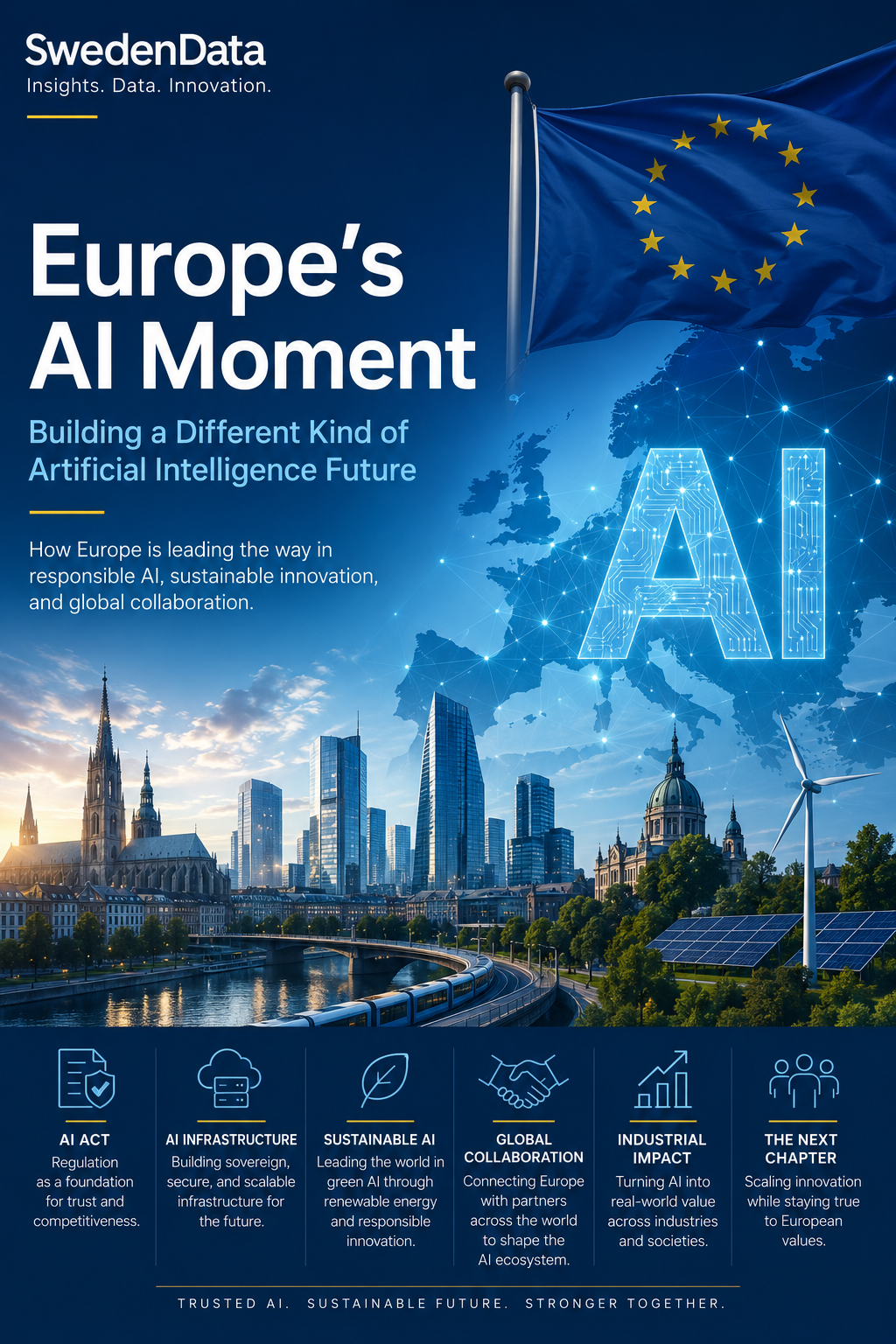
Europe’s AI Moment: Why the Continent Is Building a Different Kind of Artificial Intelligence Future
Artificial intelligence is no longer a future concept discussed only in research labs or technology conferences. Across Europe, AI is rapidly becoming part of industrial strategy, public infrastructure, enterprise operations, and digital sovereignty initiatives. While the global conversation around AI is often dominated by competition between the United States and China, Europe is quietly shaping a third path — one focused on regulation, sustainability, transparency, and long-term industrial integration.
The European AI ecosystem may not always move with the same aggressive speed as Silicon Valley, but it is increasingly positioning itself as one of the world’s most stable and trusted environments for responsible AI development.
Europe’s AI Growth Is Accelerating
Over the past two years, Europe has seen a sharp increase in AI investment, startup activity, and enterprise adoption. Governments across the European Union are introducing national AI strategies, while both public and private sectors are expanding AI-related infrastructure.
Countries such as Germany, France, Sweden, and Netherlands are emerging as important AI innovation hubs, especially in areas including industrial automation, climate technology, healthcare, cybersecurity, and enterprise software.
Unlike earlier waves of digital transformation, Europe’s AI expansion is not centered only around consumer platforms. Instead, much of the momentum is tied to real-world industries:
- Manufacturing and robotics
- Smart logistics and transportation
- Green energy optimization
- Financial compliance systems
- Healthcare diagnostics
- Government digitalization
- Enterprise productivity solutions
This industrial focus reflects Europe’s long-standing economic strengths and could ultimately become one of its biggest advantages in the global AI race.
The AI Act: Regulation as Competitive Strategy
One of the defining characteristics of Europe’s AI approach is regulation.
The European Union’s AI Act has become one of the most closely watched technology regulations in the world. While critics initially argued that regulation might slow innovation, many businesses are now beginning to see regulatory clarity as a competitive advantage.
For international companies operating across multiple markets, Europe is creating a framework where trust, accountability, and compliance are increasingly valuable assets.
This is particularly important in sectors such as finance, healthcare, public services, and enterprise infrastructure, where AI systems require higher levels of transparency and governance.
Rather than competing solely on scale, Europe is attempting to compete on reliability.
AI Infrastructure Is Becoming a Strategic Priority
Another major shift is Europe’s growing focus on AI infrastructure.
Cloud computing, sovereign data centers, GPU capacity, and AI-ready energy systems are becoming central topics in both politics and business. European governments increasingly recognize that long-term AI competitiveness depends not only on software talent, but also on control over digital infrastructure.
Several European technology firms are now investing heavily in:
- High-performance computing
- AI cloud services
- Data privacy architecture
- Green AI infrastructure
- Semiconductor partnerships
- Enterprise AI deployment platforms
This trend is also creating new opportunities for international partnerships between Europe and Asia, particularly in advanced manufacturing, smart cities, and cross-border enterprise solutions.
Europe’s Sustainability Advantage
One area where Europe may hold a unique advantage is sustainable AI.
As AI models become larger and more energy-intensive, concerns about electricity consumption and environmental impact are becoming more serious. Europe’s emphasis on renewable energy, carbon reduction, and green infrastructure may position the region as a leader in sustainable AI deployment.
Nordic countries in particular are attracting attention due to their renewable energy capacity, stable infrastructure, and advanced digital ecosystems.
For many enterprises, the future question may not simply be:
“How powerful is the AI model?”
But also:
“How sustainable is the infrastructure behind it?”
The Rise of Cross-Border AI Collaboration
AI development is increasingly global, and Europe is becoming an important bridge between regions.
European companies are actively collaborating with partners in:
- Asia-Pacific
- The Middle East
- North America
- Emerging technology markets
This cross-border cooperation is especially visible in:
- AI research partnerships
- Enterprise software deployment
- Smart manufacturing
- Fintech infrastructure
- Data security
- Public sector digitalization
For international businesses, Europe offers a combination of technological capability, regulatory predictability, and access to global markets.
The Next Phase of European AI
The next chapter of Europe’s AI story will likely depend on execution.
The region already possesses many critical ingredients:
- World-class universities
- Strong industrial foundations
- Advanced engineering talent
- Regulatory leadership
- Sustainable energy initiatives
- Growing startup ecosystems
The challenge now is scaling innovation fast enough to compete globally while maintaining the principles Europe sees as essential.
Artificial intelligence is reshaping the global economy, but Europe is demonstrating that technological leadership does not always have to follow the same model. Instead of prioritizing speed above all else, Europe is attempting to build an AI ecosystem based on resilience, trust, and long-term sustainability.
Whether this model becomes a global standard remains to be seen. But one thing is increasingly clear:
Europe is no longer simply participating in the AI conversation — it is actively redefining it.